
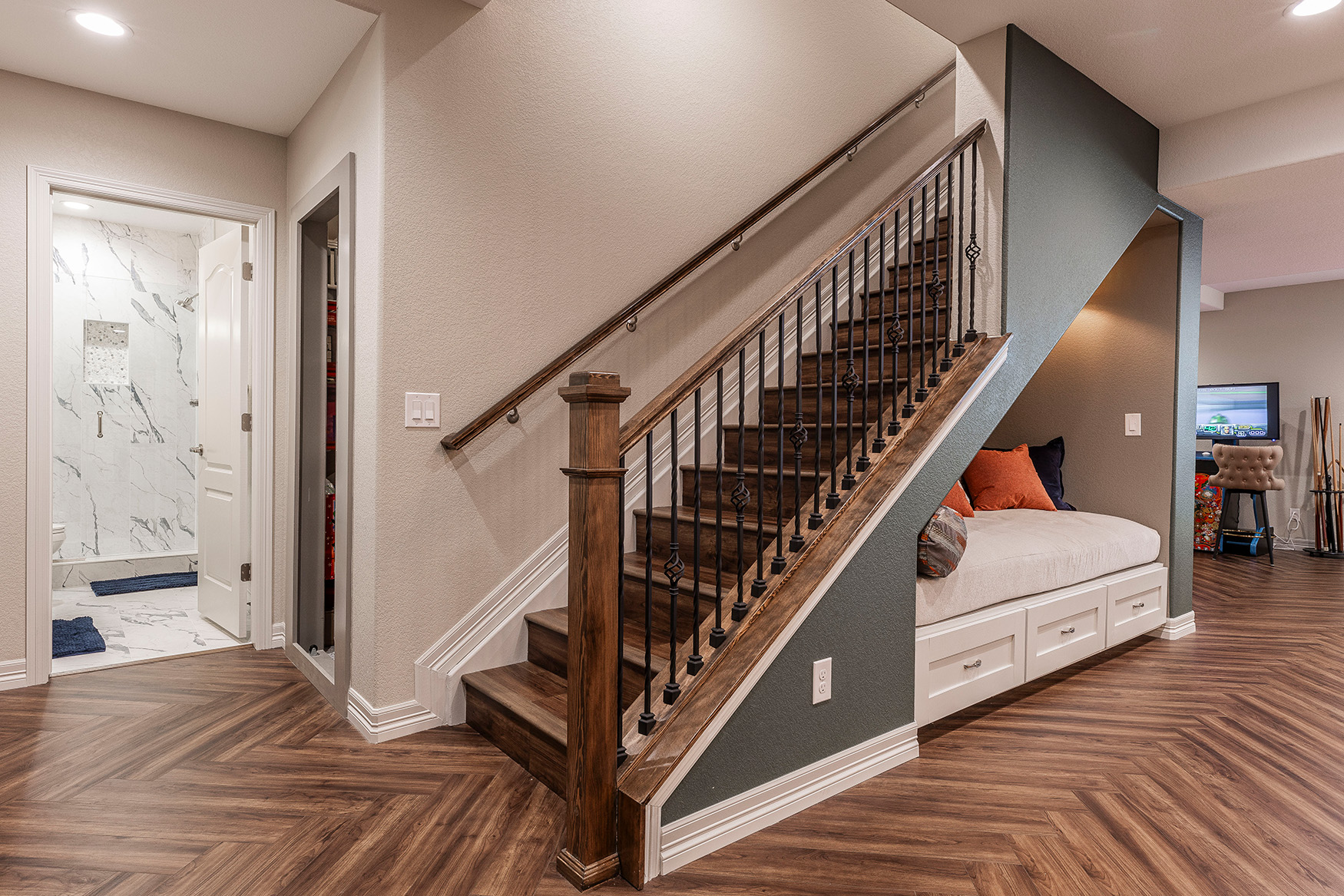
Under-stair storage is one of the highest-ROI upgrades you can add during basement finishing—especially for Colorado homeowners who care more about performance, headroom, and long-term flexibility than short-lived trends. Done right, it reduces clutter upstairs, protects valuables from basement moisture risks, and can even help your layout feel larger. Done wrong, it can become a damp closet, a code headache, or a future demo when you need access to utilities.
Below is a practical, contractor-minded approach to under stair storage basement planning—focused on safe clearances, moisture management, and designs that stay useful as your home changes.
Why under-stair storage works so well in basements
Basements often have long perimeter walls reserved for windows, egress, and furniture layouts. The wedge under stairs is a “free” volume that doesn’t compete with your main living zone—if you design it to match how you actually live (sports gear, seasonal bins, board games, Costco overflow, tools, kids’ stuff).
The common regret
Homeowners frequently build a tiny door and call it “storage,” then realize it’s awkward to access, poorly lit, and too shallow for real bins. The fix is to plan the opening size, depth, and what must stay accessible (electrical, plumbing, radon piping, cleanouts) before framing.
Start with “constraints first”: what can’t be compromised
Under-stair areas are where basements like to hide everything: drain lines, cleanouts, sump routes, radon piping, low-voltage wiring, and sometimes even HVAC chases. Before you pick drawers vs. closet doors, confirm these basics:
Colorado-specific note: radon and airflow changes
Colorado is a high-radon state, and finishing a basement can change how air moves through the home. CDPHE recommends testing and mitigating when levels are at or above the EPA action level of 4 pCi/L, and also notes radon is elevated in about 1 out of every 2 Colorado homes. If mitigation is needed, it’s typically easiest (and cleanest) to install before walls and ceilings are closed in.
If your project includes a future basement bedroom, treat egress placement and circulation as a non-negotiable. Under-stair storage should never “steal” the pathway that makes the basement feel open and safe.
Best under-stair storage layouts (and what they’re best for)
Choose a configuration based on what you’ll store and how often you need it.
| Option | Best for | Pros | Watch-outs |
| Full-height closet door (tall opening) | Bins, strollers, folding tables, sports gear | Simplest build; easiest to ventilate and light | Door swing and traffic flow; don’t block future furniture layouts |
| Pull-out drawers (deep, wide) | Board games, craft supplies, kids’ toys, pantry overflow | Uses full depth; “grab and go” access | Needs solid slides and a flat floor; plan for future service access |
| Open built-in shelving (no doors) | Decor, books, media, baskets | Budget-friendly; avoids “stuffy closet” feel | Visual clutter; more dust; not ideal for damp-prone storage |
| Hidden utility access panel (clean removable sections) | Keeping mechanicals accessible while still “finished” | Future-proof; looks intentional | Must be planned early to avoid awkward seams and trim |
Performance tip: If you’ll store paper goods, fabric, or keepsakes, consider keeping them in sealed totes and avoid placing shelving directly against foundation walls unless you’ve handled insulation/vapor strategy correctly for your basement.
Step-by-step: how to plan under-stair storage during a basement finish
1) Define what you’re storing (and the container size)
Measure your most common bins (width, depth, height). If you want to store a vacuum, skis, or a folding table, measure those too. Then design the opening so you’re not turning sideways to squeeze items in.
2) Confirm moisture risk and choose the right “storage type”
If your basement has any history of dampness, prioritize easy-to-clean finishes, sealed flooring transitions, and storage that doesn’t trap stagnant air. A closed closet packed with cardboard is a common “mystery smell” source later.
3) Plan lighting and power intentionally
A dark storage space gets ignored. A simple ceiling light or LED strip can make the area feel twice as usable. Also plan where you might want an outlet for charging, a dehumidifier, or future tech.
If you’re updating electrical as part of the basement project, remember newer code editions expanded AFCI/GFCI protections in many areas (including finished basements and unfinished basements in many cases). Your local jurisdiction and permit scope determine specifics, but it’s smart to assume modern protection will be required when finishing.
4) Build in access (even if you don’t think you need it)
Cleanouts, shutoffs, radon piping routes, or future wiring runs can turn into expensive drywall work if you block them. A clean, trim-finished access panel is one of the simplest “future flexibility” decisions you can make.
A planning shortcut that prevents layout regret
Tape the storage opening on the wall (full-size) and “walk” the basement like it’s furnished: couch, TV wall, rec room, kids’ play zone, gym corner. If the door swing or drawer pull conflicts with the way you’ll actually use the room, you’ll see it immediately.
Did you know?
Radon is common in Colorado homes.
CDPHE notes elevated radon levels are found in about 1 out of every 2 Colorado homes. If you’re finishing a basement, it’s a good time to test and address mitigation before finishes go in.
Did you know?
Mitigation costs are often manageable compared to rework.
CDPHE estimates typical radon mitigation in existing single-family homes at roughly $1,300–$3,000, with variation by layout. Planning it early can reduce routing headaches once drywall and built-ins are complete.
Where under-stair storage fits best with popular finished basement zones
Storage should support your main basement “purpose,” not fight it. Here are practical pairings that tend to work well:
- Rec room: board games, controllers, hobby bins, party supplies
- Home gym: yoga mats, bands, foam rollers, towels, cleaning supplies
- Theater room: media storage, spare blankets, projector accessories
- Wet bar/kitchenette: backstock snacks, small appliances, serving trays
If you want inspiration for how storage integrates with different basement “destinations,” explore ElkStone’s design categories like rec rooms, gyms, theater rooms, and wet bars.
Local angle: Colorado basement realities that should influence your storage plan
Colorado’s Front Range homes often deal with a mix of expansive soils, seasonal humidity swings, and radon prevalence. Under-stair storage should be designed as a finished, conditioned extension of your basement—not a sealed-off “mystery cavity.”
Three Colorado-smart moves:
1) Test for radon before finishing: CDPHE provides guidance on testing and mitigation; finishing can change airflow and how radon presents.
2) Avoid storing “sensitive” items loose: use sealed totes for paper/fabric keepsakes; prioritize airflow and cleanability.
3) Keep future access easy: even if everything looks perfect today, you’ll thank yourself later when you need to service a line, add wiring, or adjust a mitigation component.
If you’re also planning permits, egress, inspections, and radon considerations, ElkStone’s resources can help you prep your checklist: Basement finishing resources.
Want under-stair storage that’s built for real life (and won’t block future upgrades)?
ElkStone Basements specializes exclusively in basement finishing and remodeling across Colorado’s Front Range (and Utah). If you’re comparing layouts and trying to avoid “we should’ve done this differently” moments, we can help you map storage, headroom, and flexibility before construction starts.
Explore options like Express Basement Finishing or Custom Basement Finishing, depending on timeline and customization needs.
Request a Basement Consultation
Get clarity on layout, storage, and finish details before drywall goes up.
FAQ: Under-stair storage in a finished basement
Yes—because it adds usable square footage without expanding the footprint. It’s especially valuable when your finished basement needs to serve multiple functions (rec room + guest area + gym) and you want clutter contained.
Drawers are best for frequently used items and deep storage you want to access easily. A closet door is best for tall items and for keeping service access simple. If you’re unsure, a hybrid (a tall door plus interior shelving zones) is often the most flexible.
It can if it becomes a sealed cavity with poor airflow and moisture-prone contents (cardboard, fabric, loose paper). Use sealed bins, keep the space cleanable, and avoid trapping humid air—especially if your basement has a history of dampness.
In Colorado, it’s a smart step. CDPHE notes radon is common and recommends mitigation when results are at or above 4 pCi/L. Addressing mitigation before finishes go in can reduce rework later.
Plan clean access to anything you might need to service (shutoffs, cleanouts, wiring routes, mitigation components). A neat access panel is far better than cutting finished drywall later.
Glossary (helpful terms for basement storage planning)
AFCI: Arc-Fault Circuit Interrupter. A protective device designed to reduce fire risk from arcing faults on certain circuits.
GFCI: Ground-Fault Circuit Interrupter. Helps protect people from electrical shock, commonly required near moisture-prone areas.
Radon (pCi/L): Radon concentration is often reported in picocuries per liter (pCi/L). CDPHE references the EPA action level at 4 pCi/L for considering mitigation.
Access panel: A removable section of wall/ceiling finish that allows service access to plumbing, wiring, or other components without demolition.


Recent Comments