
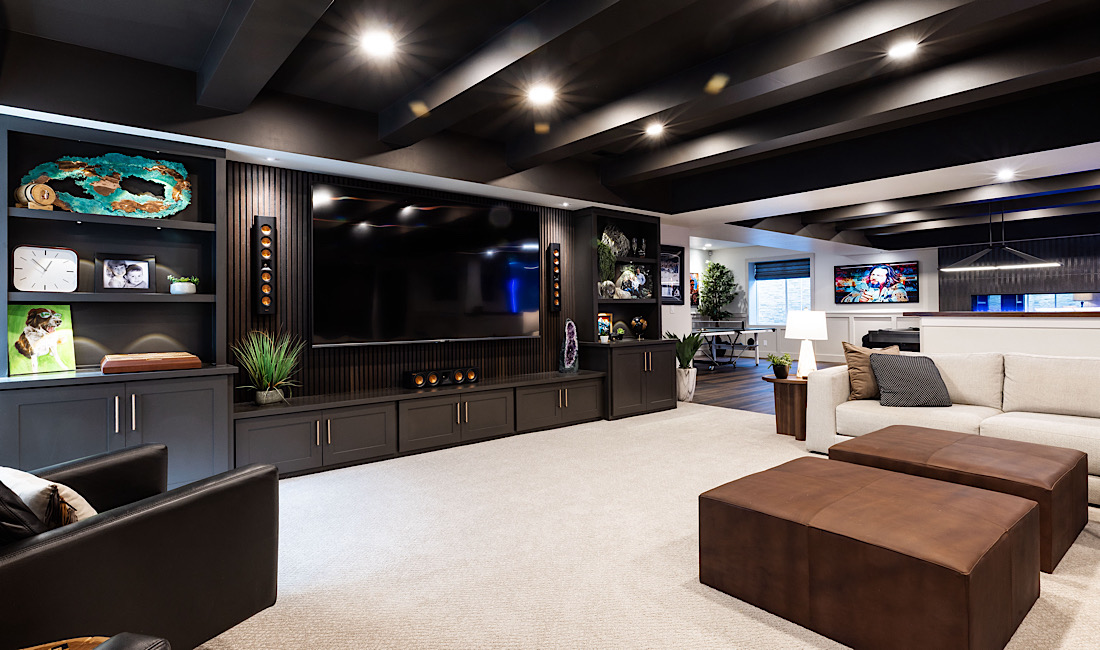
The best layout for a long, narrow basement splits the length into two to four zones, each with one job, and keeps a clear walkway along one wall. Put the rooms that need daylight near the windows, run storage along a solid wall, and mark each zone with lighting, rugs and furniture instead of full walls. That keeps the space from feeling like a hallway.
Start With What You Can’t Move
Before you sketch zones, mark the things that set the plan for you:
- The stairs. Where they land decides where the walkway starts. See our guide to basement stairs design and layout.
- Support posts and beams. In narrow basements they often run down the middle. Wrap them, or build them into a half wall, a bar or shelving. Here are support column ideas that look built in.
- The mechanical room. The furnace, water heater and electrical panel need clear access.
- Windows. They decide where a bedroom can go and where daylight lands.
- Plumbing. A bathroom or wet bar is simplest near existing drain lines.
Common Problems in Narrow Basements
- A “tunnel” feel that makes the room seem smaller than it is
- A dark middle, far from any window
- Furniture with nowhere to sit except against a wall
- No separation between quiet and noisy zones
- Dead corners and wasted space at the far end
Five Layout Plans That Work
These plans suit basements roughly 10 to 15 feet wide, or ones broken up by beams and soffits.
1. The Linear Lounge
Best for: a TV room, guest seating or a family movie spot.
Put the media wall on a short end wall and face a sectional down the length of the room. Use narrow side tables or wall shelves to keep the floor clear.
2. The Zoned Corridor
Best for: families who need one space to do several jobs.
Divide the length into zones, such as a play area, a reading nook and a lounge. Rugs, a change in lighting or a half wall tell you where one zone ends and the next begins.
3. The Split Layout
Best for: two uses, like a bedroom and an office, or a lounge and a gym.
Break the basement into two main zones with a barn door, a built-in shelf unit or an L-shaped sofa. You get separation without closing off light and air.
4. The Storage Spine
Best for: homes that need better organization.
Run built-in cabinets or shelving along one long wall. The rest of the room stays clear, and the space looks clean and finished.
5. The Mirror Plan
Best for: guests or extended family.
Place matching rooms on each side of a shared middle, such as two small bedrooms on either side of a bathroom or lounge. Each bedroom needs its own emergency escape window, so plan this one around your window locations.
Design Tips That Make a Narrow Basement Feel Wider
- Light colors. Light walls and flooring bounce light deeper into the room.
- One flooring throughout. It keeps the eye moving and makes the space read as one room.
- Plank direction. Planks that run the long way lead the eye down the room. Run them across the width to make it feel wider.
- Layered lighting. Rows of recessed lights for general light, plus wall lights or lamps in each zone. More ideas: basement lighting and maximizing natural light.
- Glass or open partitions. Glass doors or open shelving divide zones without blocking light.
- Wall-mounted furniture. Floating shelves, desks and benches free up floor space.
- Mirrors. A large mirror on a long wall makes the room read wider.
For more ideas, see small basement design ideas and the three layout mistakes to avoid.
Homeowner FAQs
Can I add a bedroom to a narrow basement?
Often, yes. Under the International Residential Code, which most Colorado cities build by, a basement bedroom needs an emergency escape opening, usually an egress window with a window well. Plan the bedroom where that window can go. More in our guide to legal basement bedroom requirements in Colorado.
What’s the best flooring for a long, narrow basement?
Vinyl plank in a light tone is the usual pick. It is water-resistant, works over concrete and keeps the space looking continuous. Carpet adds warmth in bedrooms and media rooms. Concrete floors in Colorado are never perfectly flat, so your flooring installer estimates floor prep from the condition of your subfloor and your flooring choice. Compare options in best basement flooring.
Will a narrow basement feel cramped?
Not with a plan. Clear zones, a single walkway, light finishes and good lighting make a narrow basement feel open.
What does a narrow basement finish cost?
It depends on the size, the rooms and the finishes you choose. See how much basement finishing costs in Colorado.
Plan Your Narrow Basement With ElkStone
ElkStone Basements has finished basements along Colorado’s Front Range since 2009. Learn more about basement finishing in Colorado, or book a design consultation to find the layout that fits your space. You can also call (303) 656-9006.
Recent Comments