A finished basement should feel warmer, drier, and cleaner than the rest of the house—not damp and “musty.”
Colorado winters can expose the weak spots in basements: chilly floors, condensation around foundation walls, lingering odors after snowmelt, and worries about radon or allergies. A truly energy-efficient basement in Colorado is built around building science—controlling water, air, and heat in the right order—so your new space stays comfortable for years, not just the first season.
The “3 Controls” That Make a Basement Efficient (and Healthy)
Most basement comfort and air-quality problems come from skipping a control layer or installing it in the wrong place. A high-performing basement remodel focuses on:
1) Water control (bulk moisture)
Keep liquid water out first—grading, gutters, downspouts, drainage, and fixing foundation seepage. No insulation or drywall strategy can “outperform” a wet foundation.
2) Air control (drafts + soil gases)
Air leaks are energy leaks—and in basements they can also mean soil gases. A continuous air-seal strategy helps reduce drafts and supports radon control details at the slab/wall connection.
3) Thermal control (insulation that won’t trap moisture)
Basements are different from above-grade walls. You want insulation that improves comfort and efficiency while reducing condensation risk at cold concrete surfaces.
Why Colorado Basements Are Tricky: Cold Concrete + Winter Air + Spring Melt
Along the Front Range, basements commonly face a mix of:
- Cold foundation walls can trigger condensation if warm indoor air reaches them.
- Dry winter air outside, but localized indoor moisture from showers, laundry, cooking, and humidifiers.
- Snowmelt + spring storms that reveal drainage problems around the home’s perimeter.
- Radon potential that varies by county and even neighborhood—testing is the only way to know your home’s level. The EPA recommends fixing a home at 4.0 pCi/L or higher and considering action between 2.0–4.0 pCi/L.
Did You Know? Quick Efficiency + Health Facts
- Humidity above 60% RH increases condensation risk and can contribute to mold growth; EPA guidance commonly targets below 60% and ideally 30–50% RH when possible.
- In many Colorado areas (often Climate Zone 5), basement wall insulation recommendations frequently fall around R-15 continuous insulation or R-19 cavity as a cost-effective retrofit target in colder climates.
- Building-science details often use rigid insulation against concrete to help reduce condensation risk and allow interior drying strategies (instead of trapping moisture behind a plastic vapor barrier).
Common Basement Insulation Approaches (What They’re Good At)
| Approach | Best for | Watch-outs | Efficiency impact |
| Continuous rigid foam against concrete (then framed wall) | Condensation control, comfort, durability | Needs careful sealing at seams/edges; fire-rated coverings where required | Strong—reduces thermal bridging and cold-wall effect |
| Fiberglass batts in stud wall (no continuous layer) | Budget-sensitive projects with dry, proven foundations | Higher condensation risk if warm air reaches cold concrete; performance depends on air sealing | Moderate—can underperform if air leaks exist |
| Closed-cell spray foam on concrete | Air-seal + insulate in one step; tight spaces | Cost; needs correct thickness/details to avoid gaps | Strong—excellent air control when installed well |
| “Plastic vapor barrier + batts” on interior | Rarely the best choice for basements | Can trap moisture; drying potential is reduced—details matter a lot | Risky—comfort gains can be offset by moisture problems |
Note: Exact assemblies should match your home, local code interpretation, and the condition of your foundation.
How to Plan an Energy-Efficient Basement Finish (Colorado Checklist)
1) Start with moisture proofing and drainage—not drywall
Confirm that downspouts discharge away from the foundation, slopes pitch away from the house, and any seepage is addressed. EPA notes foundations shouldn’t stay wet—drainage and grading matter.
2) Test for radon before (and after) finishing
Finishing can change how a basement “breathes.” The EPA recommends fixing at 4.0 pCi/L and considering action at 2.0–4.0 pCi/L. If mitigation is needed, it’s usually simpler to integrate before the walls are closed.
3) Insulate in a way that protects you from condensation
A common building-science strategy in colder climates is to put a continuous insulation layer (often rigid foam) against the concrete to keep interior surfaces warmer and reduce condensation risk. Details like sealing at the slab-to-wall area also help control soil gases.
4) Target smart R-values for Colorado’s climate
For colder zones (often Climate Zones 4C–6 across Colorado by region), ENERGY STAR notes basement/crawlspace wall insulation targets like R-15 continuous or R-19 cavity, depending on the assembly. This is a solid “starting point” for energy-focused planning.
5) Control indoor humidity year-round (aim for 30–50% when possible)
EPA guidance commonly recommends keeping indoor humidity below 60% and ideally 30–50% (when feasible) to reduce condensation and mold risk. In a finished basement, a properly sized dehumidifier or HVAC strategy may be part of the plan.
6) Keep the layout “future-proof” for comfort and efficiency
Plan lighting zones, outlet locations, and storage early. If you want a home gym, theater, wet bar, or rec room, it’s easier (and often more cost-effective) to integrate wiring, plumbing, and sound control during framing—not after finishes are installed.
Finishing Choices That Help Basements Feel Warmer (Without Cranking the Thermostat)
Small finish decisions can have big comfort payoffs in Colorado basements:
- Flooring: Underlayment and warmer-feeling surfaces can reduce that “cold slab” sensation.
- Air sealing + doors: A well-sealed mechanical room and thoughtful door placement can reduce noise and drafts.
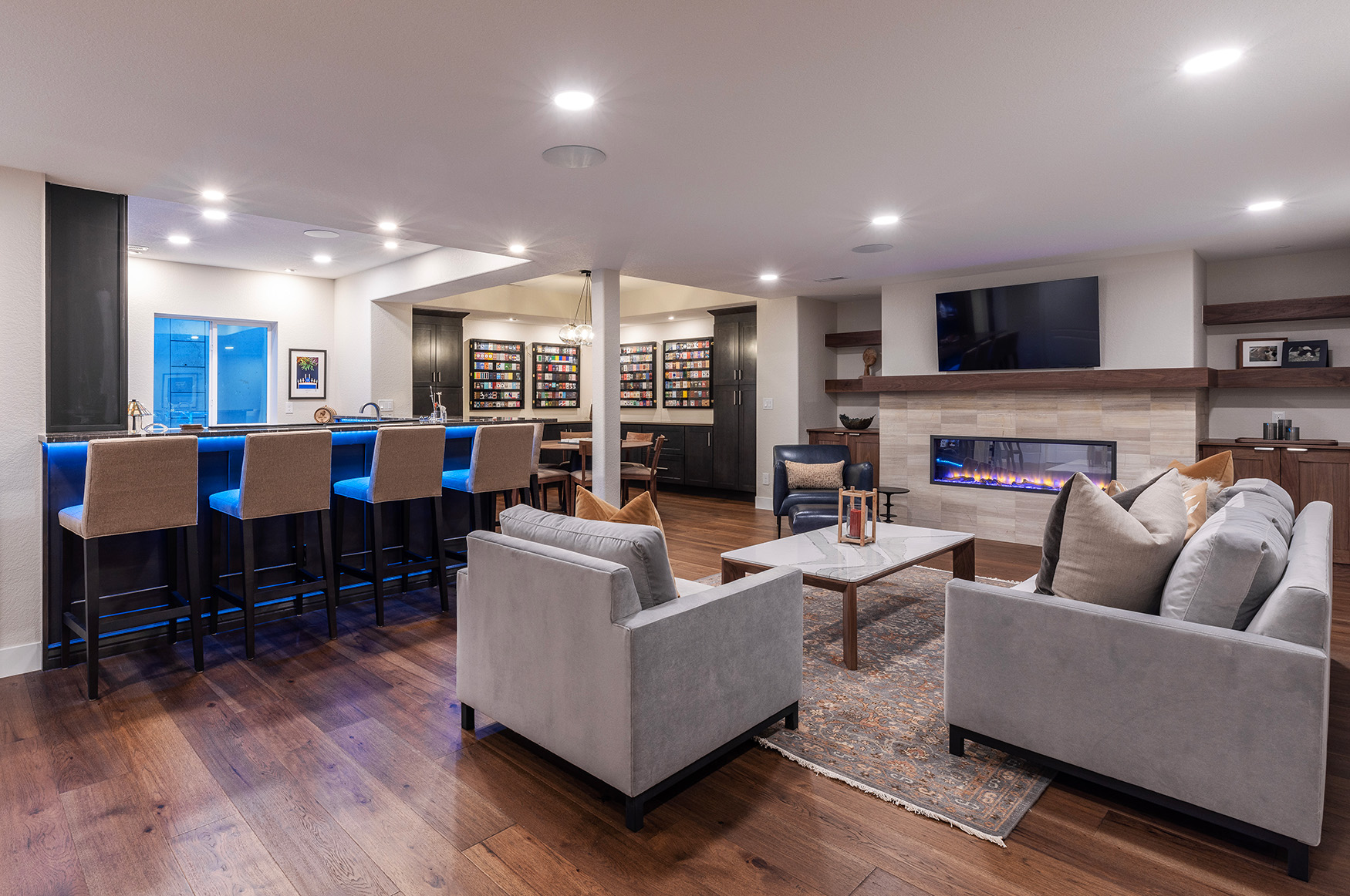
- Lighting: Layered lighting (ambient + task + accent) makes below-grade spaces feel more like main-level living.
- Ventilation strategy: If you’re adding a bathroom, kitchenette, or wet bar, exhaust and makeup air planning matters for humidity and odors.
- Smart zoning: Keep high-moisture areas (bath, wet bar) where you can ventilate and monitor easily.
If you’re exploring design options, ElkStone Basements offers inspiration for specialty spaces like custom basement gyms, theater rooms, and wet bars.
Build for Big Temperature Swings and Radon Awareness
Colorado homes often experience large daily temperature changes, and many areas have notable radon potential. The EPA’s radon zone map exists to help target resources, but it’s not a substitute for testing—radon can be elevated in any zone.
For homeowners along the Front Range, the best approach is to treat a basement finish as a performance upgrade: seal the envelope, insulate for condensation control, manage humidity, and plan mechanicals so the space stays comfortable through winter cold snaps and spring moisture events.
If your goal is speed without sacrificing the fundamentals, explore Express Basement Finishing for a streamlined path to a finished space—then customize with features like basement bathrooms or a kitchenette.
Ready for a basement that’s efficient, comfortable, and built to last?
ElkStone Basements specializes exclusively in basement finishing and remodeling—so the details that protect comfort, air quality, and durability aren’t an afterthought. If you’re planning an energy efficient basement finish in Colorado, we’ll help you choose the right insulation and moisture-control approach for your home and goals.
Contact ElkStone Basements | View Basement Ideas & Portfolio
FAQ: Energy-Efficient Basement Finishing in Colorado
EPA guidance commonly recommends keeping indoor relative humidity below 60%, and ideally around 30–50% when possible to reduce condensation and mold risk.
Yes—testing is the only way to know your home’s radon level. The EPA recommends fixing at 4.0 pCi/L or higher and considering action at 2.0–4.0 pCi/L.
Many Colorado homes fall into colder climate zones where ENERGY STAR guidance commonly points to basement wall insulation targets around R-15 continuous or R-19 cavity, depending on assembly. Your best target depends on your existing foundation, moisture history, and how the space will be used.
It can—if water control, air sealing, and condensation-aware insulation aren’t planned correctly. A high-quality finish typically starts with drainage/moisture fixes, then air sealing and insulation strategies that keep cold surfaces warm and allow appropriate drying.
Many homeowners use a fast finishing path as the “foundation,” then add custom features—like a rec room,fireplace, or family room—once the core performance details are handled.
Glossary
R-Value: How well insulation resists heat flow. A higher R-value means better insulating performance for that layer.
Continuous Insulation (CI): Insulation that runs uninterrupted across framing members, reducing thermal bridging (heat loss through studs).
Condensation: Liquid water forms when warm, moist air hits a colder surface (often a foundation wall). Managing humidity and keeping surfaces warmer reduces risk.
Radon (pCi/L): A naturally occurring radioactive gas that can enter homes through the ground. The EPA recommends action at 4.0 pCi/L and considers action at 2.0–4.0 pCi/L.
Air Sealing: Closing gaps and penetrations that let uncontrolled air move through the building envelope—improves comfort and supports moisture and soil-gas control strategies.


Recent Comments