
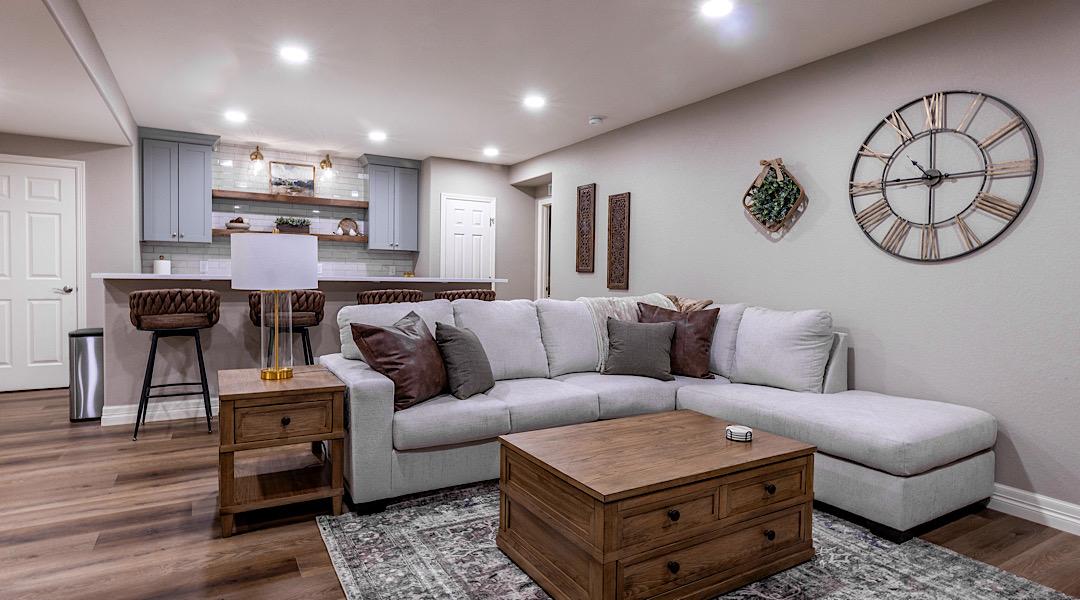
A smarter way to budget: define the scope, control the variables, and keep the schedule intact
If you’re a Colorado homeowner planning a basement finish for summer, you’re likely “execution-ready”: you want a clean scope, a clear number, and a timeline that doesn’t slip. The fastest way to protect your budget isn’t hunting for the cheapest line item—it’s choosing decisions that reduce rework, avoid surprises behind the walls, and keep inspections moving. Below are practical, contractor-friendly basement finishing budget tips that help you get a predictable price and a basement you’ll still love years from now.
What actually drives basement finishing cost in Colorado?
Most homeowners start by asking for a price per square foot. That can be useful for a first pass, but basements are full of “scope multipliers”—bathrooms, wet bars, custom theaters, structural posts, low ceilings, and moisture management. National 2026 guidance commonly places basic-to-mid basement finishes in a wide range (often roughly $20–$75+ per sq ft, with high-end spaces exceeding that). Your Colorado number depends less on square footage and more on how many complex rooms you’re building and what the existing conditions look like.
The “big five” budget variables (and how to control them)
Budget tip #1: Pick a layout that minimizes “high-cost linear feet”
A basement can look “simple” on paper but become expensive when you add lots of corners, hallways, and small rooms. Each extra wall adds framing, drywall, insulation, electrical drops, outlets, baseboard, paint, and inspection complexity.
Fast wins that protect your budget
If you want inspiration for how entertaining spaces can be designed without “over-building,” explore ElkStone Basements’ design options like rec rooms, family rooms, and specialty spaces.
Budget tip #2: Use basement flooring choices that match real-life Colorado risks
Basements and water are always part of the same conversation. Even if your basement has never flooded, moisture events happen—from spring runoff, window well drainage issues, a failed sump, or a water heater line. A “good deal” on flooring can become expensive if it can’t tolerate occasional moisture.
| Flooring option | Best for | Budget impact | Moisture tolerance |
|---|---|---|---|
| LVP (Luxury Vinyl Plank) | Family rooms, rec rooms, hallways, flexible spaces | Typically cost-effective for large areas | Good (product-dependent; still needs proper prep) |
| Tile | Bathrooms, wet bar zones, entries, high-spill areas | Higher labor cost; strong long-term value | Excellent |
| Carpet | Cozy family zones, kids’ play spaces, media lounges | Often lower up-front cost | Fair (can be impacted by moisture events) |
| Rubber gym flooring | Home gyms, training zones, heavy equipment | Moderate; great durability per dollar | Good (still requires moisture-smart assembly) |
If you’re building entertaining features, plan the flooring at the same time as the layout. For example, pairing tile near a custom wet bar or a basement kitchenette can reduce long-term maintenance headaches.
Budget tip #3: Spend early on moisture-smart assemblies (it’s cheaper than repairs)
Colorado has big temperature swings, and basements sit against cold concrete. If a wall assembly traps moisture, it can lead to odors, staining, and materials that need to be removed. A budget that looks great on paper can collapse if you have to demo drywall later.
Moisture-smart choices that support predictable pricing
If you’re planning a basement theater or home gym, moisture and comfort planning is even more important—sound insulation, equipment, and seating all work better in a space that stays consistently dry.
Quick “Did you know?” facts that affect basement budgets
Did you know: bedrooms can trigger egress work?
Adding a basement bedroom often means you’ll need to confirm emergency escape and rescue opening requirements. If you plan the bedroom early, you can price egress work accurately and avoid last-minute redesigns.
Did you know: “change orders” are usually schedule problems first?
A mid-project upgrade isn’t just the added cost of materials—it can interrupt trades, inspection timing, and procurement. A detailed selection plan up front is one of the best ways to keep timelines intact.
Did you know: a “simple” wet bar can become a “mini kitchen” fast?
Cabinets and counters are straightforward; plumbing, electrical, ventilation, and appliance decisions are where budgets expand. Define whether you want a basic beverage station or full functionality.
Budget tip #4: Choose a scope you can finish confidently (and keep future options open)
The best budgets are the ones you can actually complete. If you’re trying to hit a number, aim for a finish scope that feels complete (lighting, trim, doors, storage, paint) rather than spreading your dollars thin across too many rooms.
A practical “phasing” approach that still looks finished
If speed and predictability are the priority, consider a package-driven approach like Express Basement Finishing to lock in a clear scope and reduce decision fatigue.
Local angle: finishing a basement along Colorado’s Front Range
Along the Front Range, you’ll see a mix of older homes and newer builds—each with different budget “gotchas.” Older basements may have low ceiling heights, uneven slabs, or older mechanical layouts. Newer basements may be easier to plan but still require careful choices around airflow, sound control, and moisture-smart wall assemblies.
Front Range budgeting checklist
Want to see what “finished and cohesive” can look like? Browse ElkStone Basements’ portfolio for layout ideas and feature combinations that fit real homes.
Ready for a clear scope and a reliable timeline?
ElkStone Basements specializes exclusively in basement renovations—so the process is built around speed, quality, and predictable outcomes. If you want an estimate that’s tied to a defined scope (not vague allowances), request a consultation.
FAQ: Basement finishing budgets
What’s the best way to get an accurate basement finishing quote?
Provide a defined layout, list the “must-haves” (bathroom, wet bar, theater, gym), and confirm your key selections (flooring type, door style, trim level). The more decisions made up front, the fewer allowances and surprises you’ll see later.
Should I finish a basement bedroom if I’m trying to keep costs down?
Bedrooms can add costs tied to egress requirements, closets, and sometimes additional electrical and HVAC planning. If you don’t need a legal bedroom, a flexible guest room/office can often deliver the same day-to-day benefit with fewer code-driven upgrades.
Where should I avoid “saving money” in a basement?
Avoid under-investing in moisture management, air sealing, and core mechanical planning. Cosmetic finishes can be upgraded later, but hidden problems behind walls are expensive and disruptive to fix.
Is a wet bar worth it, and how do I keep it within budget?
A wet bar is one of the highest “lifestyle-per-dollar” upgrades when entertaining is a priority. To keep costs controlled, define the level: beverage fridge + sink + storage versus full cooking capability. The latter can add electrical, ventilation, and appliance scope.
How can I protect my summer timeline?
Lock the scope early, finalize selections before work starts, and choose a contractor with a repeatable process for scheduling trades and inspections. Predictable timelines come from predictable decisions.
Glossary (helpful basement-finishing terms)
Allowance
A placeholder budget amount used when a product or finish hasn’t been selected yet (for example, “$X for lighting”). Allowances can make quotes look lower than the final total if selections exceed the placeholder.
Egress
A code-required emergency escape and rescue opening (often an egress window) commonly associated with basement bedrooms. Requirements vary by jurisdiction and must be confirmed with local building departments.
Continuous insulation
Insulation installed in an unbroken layer (often rigid foam) that reduces thermal bridging and helps control condensation risk on basement foundation walls.
Rim joist
The framing area at the top of the foundation wall where the house framing meets the foundation. It’s a common air-leak zone and often benefits from targeted air sealing and insulation.

Recent Comments