Express vs. Custom Basement Finishing in Colorado: Which Remodel Fits Your Timeline, Budget, and Lifestyle?

All Posts

A faster basement finish can be the right choice—if you know what you’re trading (and what you’re not).

Colorado homeowners shopping in late spring and early summer tend to want the same things: a predictable schedule, a clear scope, and a contractor who can execute without endless change orders. If you’re comparing express basement finishing to a fully custom basement remodel, the best answer usually comes down to one question: How much design flexibility do you need versus how much timeline certainty you want?

What “Express Basement Finishing” typically means (and why homeowners choose it)

An express approach is a streamlined basement finishing path built around repeatable layouts, pre-selected (or limited) finish options, and a tight process—so your contractor can control variables that usually cause delays (material lead times, scope creep, and redesign cycles). In practice, this works well when you want a high-quality finished basement but don’t need every element to be one-of-one.

For many Front Range families, express finishing is the “get it done, done right” option—perfect for a family room, rec room, guest space, or a flexible hangout zone that needs to be ready before the school-year routines return.

What “Custom Basement Finishing” unlocks (and when it’s worth it)

Custom basement finishing is best when your basement needs to match a specific lifestyle—either because you’re integrating multiple specialty zones or because your home’s layout demands creative solutions. This is where you’ll see projects centered around:

Purpose-built entertainment
Theater rooms, specialty TV walls, built-ins, and lighting/acoustics planned from the framing stage.
Entertaining upgrades
Wet bars, kitchenettes, beverage centers, upgraded electrical, and plumbing coordination for sinks/ice makers/refrigeration.
Comfort + usability additions
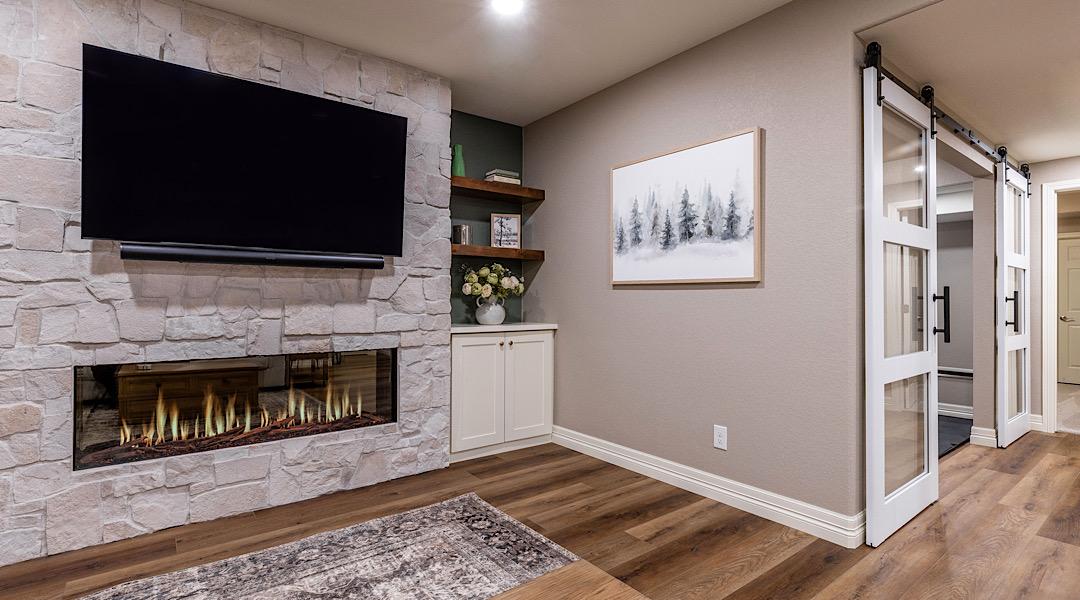
Bathrooms, fireplaces, gyms, and smarter storage—features that change how often the basement gets used.

Express vs. Custom: the decision framework that prevents regret

If you’re execution-ready, this framework keeps the decision simple. Choose the path that matches how your basement will be used in real life, not just on design boards.

Decision FactorExpress Basement FinishingCustom Basement Finishing
Timeline predictabilityHigh—fewer open-ended choices and fewer rework pointsModerate—depends on design complexity, specialty trades, and lead times
Design flexibilityCurated—great finishes, fewer unique elementsMaximum—built-ins, specialty rooms, unique layouts, high personalization
Budget controlStrong—defined scope reduces surprise upgradesStrong with discipline—best when specs are finalized early
Best fit forFamily room, rec room, flexible open space, guest hangoutTheater, wet bar/kitchenette, gym, fireplace feature, multi-zone layout
Change orders riskLower—fewer “moving targets”Higher—small changes can ripple into framing/electrical/HVAC

Process checkpoints that keep “fast” from turning into “rushed”

Speed only helps if quality and compliance stay intact. Whether you choose express or custom, a professional basement-only team should be able to explain their checkpoints clearly:

1) Moisture and air-control plan (before finishes)
Basements are different than main-level remodels. A good plan addresses moisture management, insulation details, and how wall assemblies will be finished safely (including appropriate barriers over foam products where required).
2) Egress clarity if you want a bedroom
If you’re planning a basement bedroom, egress requirements matter early (window/well sizing and placement can affect framing, landscaping, and cost). This is one of the most common “late surprises” when homeowners decide on a bedroom after design is underway.
3) Trade coordination for bathrooms, bars, and kitchenettes
Plumbing and electrical changes can create inspection dependencies. Your contractor should map rough-in timing, fixture selections, and inspection steps so the schedule stays predictable.

Did you know? Quick Colorado basement facts that affect scope and schedule

Legal bedrooms need compliant egress
Most jurisdictions follow IRC-based standards requiring an emergency escape and rescue opening in basement sleeping rooms. Planning this early helps prevent redesigns after framing starts.
Radon is a normal part of Colorado basement planning
Colorado is widely recognized as a higher-radon region, and homeowners often plan testing/mitigation when finishing lower levels—especially if the basement will be used daily.
Insulation details can trigger permit-plan revisions
Basement wall assemblies, foam protection, and insulation placement are frequent plan-review checkpoints—getting the assembly right on the front end helps keep projects moving.

Colorado Front Range angle: what busy summer schedules change

Along Colorado’s Front Range, summer is prime time for projects—yet it’s also when homeowners are traveling, kids are home, and decisions need to be made quickly. If you want the basement done with minimal disruption, here’s how to choose:

Pick express if you want predictable momentum
If your goal is a clean, functional basement—fast—an express package helps limit decision fatigue and keeps the work moving even when your calendar is packed.
Pick custom if the basement has to “solve” something
If you need a gym that actually works, a theater with intentional acoustics, or a wet bar that’s built for hosting, custom planning earns its keep—because it reduces the risk of finishing a basement that still doesn’t fit your life.

A simple next step: get a scope you can compare apples-to-apples

Whether you’re leaning express or custom, the best “shopping tool” is a written scope: what’s included, what’s excluded, what triggers a change order, and what the inspection path looks like. That’s how you protect your timeline.

Prefer to learn more about the team and process first? Visit The ElkStone Experience.

FAQ: Express vs. Custom Basement Finishing

Is express basement finishing “lower quality”?
Not by default. “Express” usually means the scope and selections are controlled to reduce delays—not that craftsmanship is optional. The key is verifying what materials, inspection steps, and warranties are included in writing.
When does a basement project “need” to be custom?
When you’re adding a bathroom, wet bar/kitchenette, specialty rooms, built-ins, fireplaces, or a multi-zone layout that depends on specific electrical, plumbing, and HVAC planning. Custom shines when the basement has to function like a true main-level extension.
Can I start with express and upgrade later?
Often, yes—especially if the basement is planned with “future-proofing” in mind (smart layout, sensible electrical planning, and leaving room for later features). Ask your contractor which upgrades are easiest later (finishes) versus hardest later (plumbing, structural, or egress changes).
What’s the biggest cause of basement remodel delays?
Unfinalized scope and selections. Every time a layout changes after rough-in, multiple trades can be affected. A clear scope, a locked selection set, and a documented process are the best defenses.
Do I need permits to finish a basement in Colorado?
In most Colorado jurisdictions, yes—especially when you add walls, electrical, plumbing, or create habitable space. Your local requirements vary by city/county, so the safest move is to confirm the permit path before construction starts.
Does ElkStone only work in Colorado?
ElkStone Basements serves Colorado’s Front Range and also offers basement remodeling and finishing in Utah. If you’re comparing options in either market, ask for a scope that matches your timeline and goals.

Glossary (quick definitions)

Egress (emergency escape opening)
A code-required window or door opening that provides emergency exit and rescue access—especially important for basement bedrooms.
Rough-in
The stage where electrical, plumbing, HVAC, and framing are installed before drywall and finished surfaces.
Change order
A written modification to the original scope of work that can affect price, timeline, or both.
Radon mitigation
A system designed to reduce indoor radon levels—commonly discussed in Colorado homes, especially when basements become everyday living space.

Archives